

For a 10–200 person business
Your business memory.
Put to work.
Ask what you know. Trace why. Explore what’s missing.
The actual problem
What your business already knows keeps quietly evaporating
Not “knowledge management.” A supplier changes a spec and the note lives in an old email thread. A pricing exception outlives the reasoning behind it. A manual gets reissued and nobody can say what decisions assumed the old version. Three people research the same question, months apart, each starting from zero. The problem was never a lack of documents — it’s that nothing holds the link between a conclusion and the evidence and decisions behind it.
Illustration — fictional company and content, walked through step by step
A document changes. Piko tells you what that touches.
No wiki, shared drive, or chatbot tracks the link between a document and the decisions that rest on it. Piko does, end to end.
Meridian Fabrication Co. specifies gasket material GX-40 from a supplier bulletin on file since March. The supplier reissues the bulletin. One sentence changes: the maximum operating temperature drops from 140°F to 120°F, on page 3.
The citation your original spec sheet relied on no longer resolves to current text. Piko re-anchors it to the new bulletin and checks every decision that cited the old passage.
Nothing is silently updated and nothing is silently broken. A person reviews the two decisions, in the order that actually matters, instead of finding out from a customer.
Piko — reissue impact
- Source replaced
- GX-40 supplier bulletin, reissued (page 3)
- Change detected
- Max operating temperature: 140°F → 120°F
- Citations re-anchored
- 1
- Decisions affected
- 2, ranked by commitment date
“2 decisions depend on this changed requirement. One has a commitment on 2 November; review it first.”
Real interface — example data
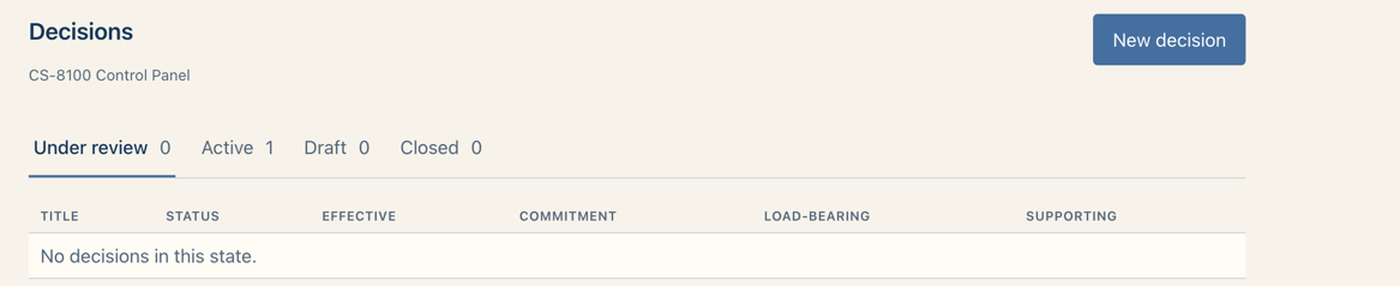
A decision is a record, not a memory
Decisions rest on approved claims and carry an audit trail. New material that contradicts something approved raises a flag for a person — it never silently overwrites approval.
Every decision carries its own lifecycle — under review, active, draft, or closed — plus the load-bearing and supporting evidence behind it, so a flag for a second look has somewhere specific to land.
Example data Piko Console — Decisions
Under the hood — example data
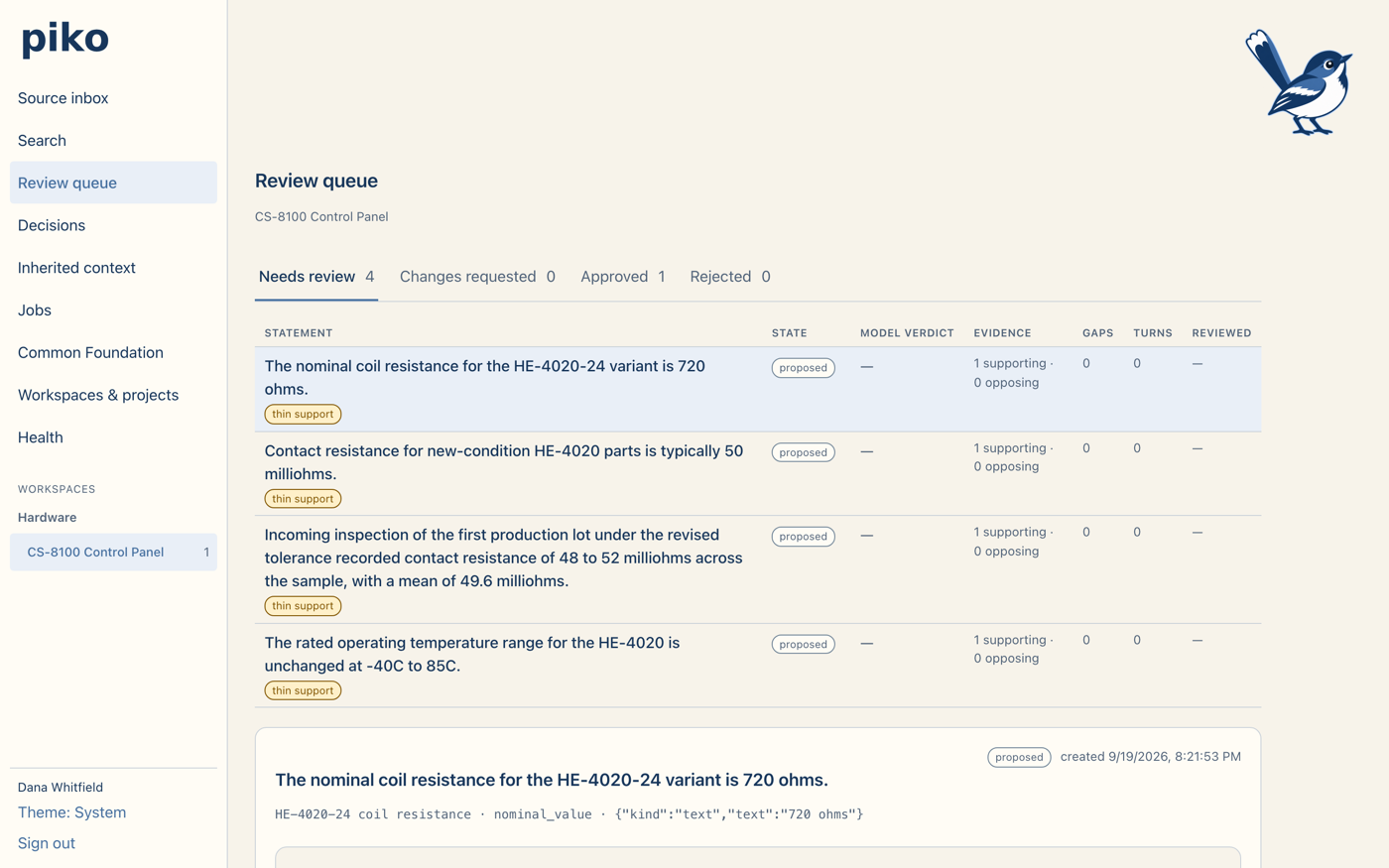
Every proposed claim shows its work
Every claim behind an answer carries a quote checked verbatim against its source before it was ever stored. The Console distinguishes an approved position from an assumption still awaiting review — it never presents one as the other.
 Decision panelApprove, reject, or return.
Approval stateNot yet approved.
Verified quote1 supporting citation, checked against its source.
Evidence healthFlags when a claim’s support is thin.
Decision panelApprove, reject, or return.
Approval stateNot yet approved.
Verified quote1 supporting citation, checked against its source.
Evidence healthFlags when a claim’s support is thin.
- Approval stateProposed — not yet approved.
- Evidence healthFlags claims whose supporting evidence is still thin.
- Verified quoteEach supporting citation is checked against its source before it’s stored.
- Decision panelTracks whether a claim needs review, has changes requested, or is approved or rejected.
The list that makes the rest believable
What’s available, and what’s planned
Every public capability is marked available or planned — no exceptions, no soft language standing in for a status that doesn’t apply yet.
| Capability | Status |
|---|---|
| Local model inference, zero non-loopback TCP sockets across model daemon, worker, and Console | Available |
| Every proposed claim carries a quote verified verbatim against its source before storage | Available |
| Human review queue: approve, reject, or return a claim, tied to an authenticated session | Available |
| Adversarial examination: the model argues the opposing side from cited evidence and names unanswerable gaps | Available |
| Decisions as first-class records resting on approved claims, with an audit trail | Available |
| The reissue case end to end: source replaced, citations re-anchored, affected decisions ranked by commitment date | Available |
| Challenges: contradicting new material raises a flag for a human and never auto-changes approval | Available |
| Durable jobs, backup and restore, verified to reproduce hashes, citations, permissions, and approvals | Available |
| Connecting external AI assistants over MCP | Planned |
| Cloud model providers and paid web search | Planned |
| A hosted or multi-company offering — today Piko runs only on hardware the business owns | Planned |
| Mobile apps and third-party integrations | Planned |
What’s actually built
Five pillars, each labeled by what it actually is today
Every public claim on this site is marked available, pilot, or planned. Nothing here states a capability that isn’t demonstrated on the reference machine.
Put knowledge within reach
Ask through the Console and get a focused answer with its evidence attached. Connecting your own AI assistant over MCP is planned, not available yet — today access is direct, through the local Console.
Available (Console)Keep your resident analyst close
Piko runs on hardware you own. Local retrieval, citations, and the review queue keep working when the internet or a cloud login doesn’t. Working locally. Web research is paused.
AvailableVerify before it’s kept
Every claim the model proposes carries a quote checked verbatim against the source before it’s stored. A quote that doesn’t verify is not recorded.
AvailableArgue the other side
On request, the model raises the opposing case using only cited evidence, and names the gaps it can’t answer. Dispatching those gaps as scheduled research is planned; today you read them and decide.
AvailableMaintain a shared foundation
Decisions rest on approved claims and carry an audit trail. New material that contradicts something approved raises a flag for a person — it never silently overwrites approval.
AvailableSaid plainly
Who Piko is not for
Ruling people out is more honest than a longer benefits list.
- A business that won’t put someone on the review queue. Piko’s safety property depends on a person actually approving, rejecting, or returning claims.
- A business with no documents or decision history worth tracing. There’s no evidence for Piko to anchor to, and no reissue case to catch.
- A business that wants a confident answer without a source. Piko is slower and shows gaps instead of guessing.
- A business that needs a hosted, mobile, or multi-company product today. Piko runs only on hardware the business owns, with no mobile app or third-party integrations yet.
Honest objections
Questions worth asking before a pilot
This needs a dedicated machine — that’s real friction.
Yes. And that’s the basis of the outage resilience and the no-per-token-fee claim — stated plainly, not hidden in an FAQ.
A review queue means more work for us, not less.
By design. Human approval is an accountable judgment, not a guarantee of truth. The honest framing is that review replaces three people re-researching the same question from zero — it doesn’t remove judgment.
Is this even finished?
No. It’s a working appliance under active construction, proven on a reference machine, not a released product. A pilot tests usefulness, review burden, and operating cost on your own material.
Is the model always right?
No. It proposes, a person disposes. Every claim carries a quote verified against the source before storage, but approval is a human decision Piko records — never validated truth.
Does this replace our AI assistant?
Not yet. Connecting external assistants over MCP is planned, not available. Today, access is direct, through the local Console.
Is local research free?
No. Local inference has no per-token model fee, but hardware, electricity, support, and any optional external services still cost money.
See it, or bring us something real to try it on
There’s no pricing or availability date yet. A pilot is a scoped evaluation of usefulness, review burden, and operating cost — on your own material.
